
Browse articles
- Getting started
- Start your first project
- Model your project
- Critical path and automatic dates
- Read and rebalance the swimlanes
- Get oriented on the schedule
- Going further
- Give overhead a home with admin projects
- Structure large projects
- Baselines and versions
- Change Gantt bar colours
- Set a revenue target on the schedule
- Getting started
- How Monument models finance
- Revenue from resourcing
- Fixed fees
- Budgeting costs
- Recording expenses
- Recording revenue entries
- Going further
- Formula based pricing and construction cost
- Recurring and periodic fees
- Revenue from expenses
- Modifiers: contingencies and discounts
- Progressive billing
- Pricing templates
- Operational expenses
- Getting started
- Read your Dashboard
- Build a custom report
- Edit a saved report
- Filter a report
- Formula columns
- Freeze a report into a snapshot
- Reports on a project
- Definitions: how each figure is worked out
- Going further
- Time-Series Columns
- Organise your work with tags
- Break reports and accounting down by office
- Control access to business finances
- Control access to rates
- Control who can create projects
- Control project administration
- Control staff and team management
- Control expenses and claims
- Control report definition editing
- Control access to contacts
- Give full project control with Owner
- Manage project work without changing money
- Let project members edit tasks safely
- Share a project safely with Viewer
- Let a team lead coordinate shared work
- Share teammate profiles without management access
- Keep team members focused on their own work
Budgeting costs
A fee tells you what a stage earns, not what it costs to deliver. Plan expense items on the cost side and watch profit fall out as the gap between the two.
What you'll achieve
Plan what a stage costs to deliver, so its margin is the gap between the fee and the cost rather than a guess.
You'll end up with: A stage with planned cost items, labour from allocations plus any fixed or recurring costs, and a margin that updates as you tune them.
Before you start
Knowing what a stage earns tells you nothing about whether it's actually worth doing. What matters is what's left once the work is delivered, and that number doesn't exist until you've planned the other half of the ledger: cost. Revenue on its own is a fee. Revenue with a real cost budget against it is a margin you can trust.
We'll budget an outside cost on Riverside Apartments' staffed Concept Design stage. Sarah Chen's allocation already provides visible revenue and labour cost, so the new consultant cost reads against a real commercial baseline rather than turning an empty stage into a pure loss.
Cost is a list of items, the same as revenue
A stage's cost isn't a single figure any more than its revenue is. It's a list of expense items that sum to a cost total, running through the exact same engine covered in how Monument models finance. Only the side of the ledger changes.
That's why margin was never something you type in directly:
margin = revenue − cost
Revenue items shape one side, expense items shape the other, and margin is simply whatever the gap between them happens to be at any moment. Add a cost and margin shrinks. Cut resourcing and margin grows. Keeping the two lists apart is exactly what makes profit something you can watch happen, rather than something you have to estimate.
Where a cost's value comes from
Adding a cost item to a stage's Expenses breakdown offers a shorter menu than revenue does:
- From Allocations: hours times the cost rate. This is the default, the moment someone is put on a stage, their cost appears here without you doing anything. Start with planning by role, then hand the work to staff.
- Fixed Amount: a lump sum you type, a sub-consultant's quote or a one-off bill.
- Recurring Amount: a cost that repeats across the stage's dates, a monthly software seat or an equipment hire.
- Formula: a cost derived from some other figure, the same mechanism fees use. See formula-based pricing.
Every resource carries two rates. The charge-out rate is what the client is billed; the cost rate is what that person actually costs the firm. The exact same allocated hours feed two separate From Allocations items, one at each rate, and the gap between those two items is your margin on that labour. Sarah Chen billed out at three hundred dollars an hour while costing one hundred and fifty is a one hundred and fifty dollar an hour margin on her time alone, and Monument shows both figures side by side rather than making you do that subtraction yourself.
Labour cost usually needs no setup at all
You rarely create the main cost item by hand. The moment Sarah Chen is allocated to Concept Design, a From Allocations cost item shows up on the Expenses side automatically, valued at her hours times her cost rate. Staff a stage and its labour cost is already budgeted, no extra step required.
That's also why cost and margin react the instant you touch the team. Put a junior on instead of a senior, lighten an allocation, change who's doing the work, and the From Allocations cost recalculates on its own. Under a fixed fee especially, where revenue can't move, every dollar saved there lands straight in margin.
Add a cost beyond labour and watch the margin move
Most stages carry cost that isn't labour. On Concept Design, Northlight Architects is bringing in an outside consultant for a fixed six thousand dollars, and since the fee itself won't move, the margin is what absorbs it.
- 1
Open staffed Concept Design and read its positive allocation revenue first.
- 2
Read the current margin against Sarah Chen's existing labour cost.
- 3
Open the Expenses breakdown. Revenue remains visible as the commercial context for the cost budget.

- 4
Add a new expense item and choose Fixed Amount.
- 5
Name it Consultant Fee and set the amount to six thousand dollars. Cost rises by six thousand dollars and margin falls by the same amount against unchanged revenue.
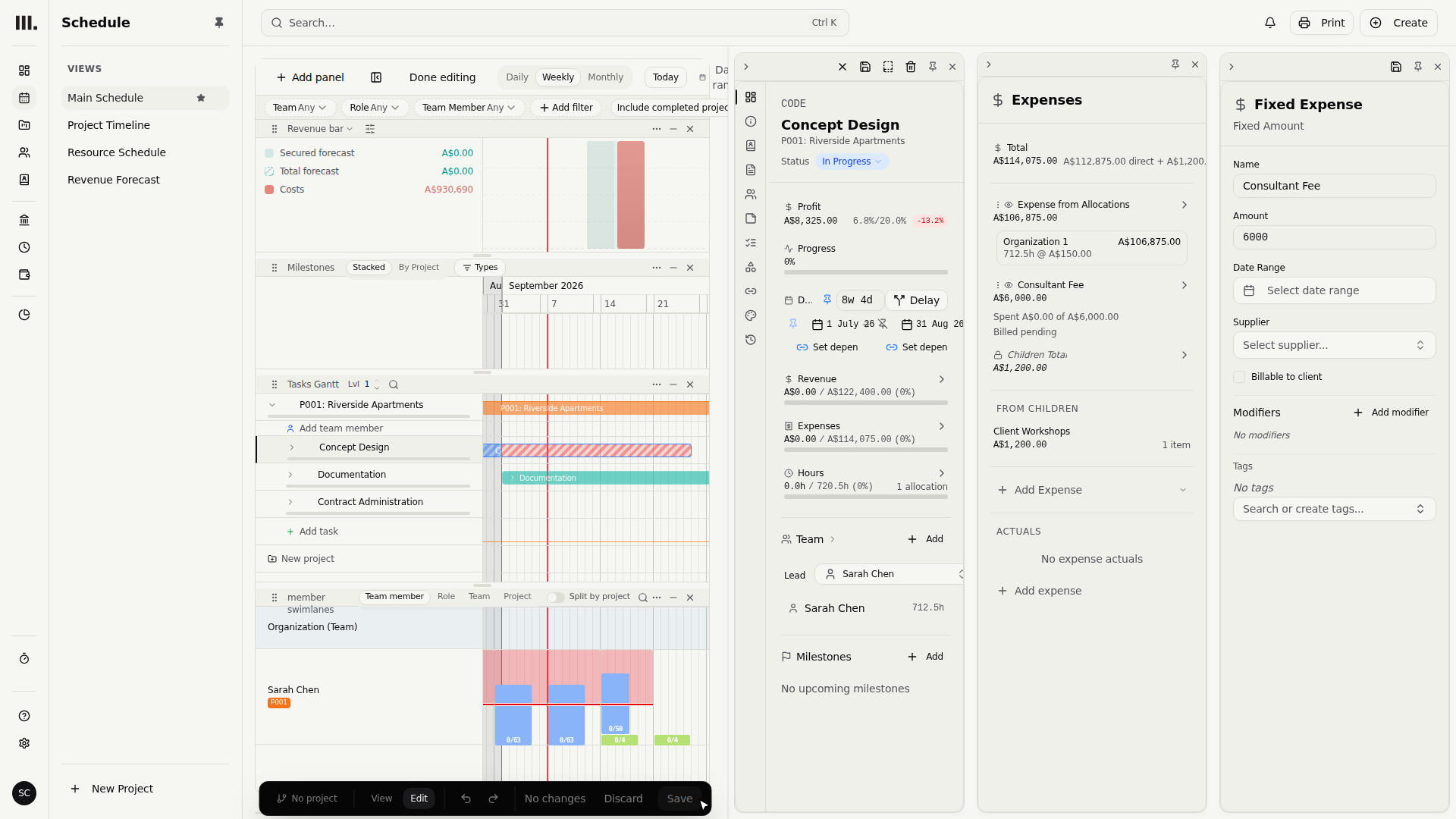
The cost side is where margin becomes something you can steer
This is the actual payoff of budgeting cost explicitly rather than skipping it. With revenue fixed and cost itemised, the margin is live: pull a few senior hours off Concept Design and both the labour cost and the margin respond immediately. The question stops being what this stage will earn and becomes what the practice can afford to deliver it for, and the answer keeps updating as you move the pieces underneath it.
A cost item can be hidden the same way a revenue item can, still calculating, just excluded from the total. That's a fast way to compare a margin two ways, with a sub-consultant and without one, say, without deleting a figure you'll only end up retyping.
Troubleshooting
- Labour cost isn't showing up. The From Allocations cost item only carries a value once someone is both allocated to the stage and has a cost rate set. Missing either one leaves the cost item blank and the margin looking better than it is.
- The cost figure looks like the fee. Revenue From Allocations uses the charge-out rate; cost From Allocations uses the cost rate. They're separate items on separate sides, so don't read a charge-out number as if it were a cost.
- A fixed fee can hide overspend until you look at cost. A fixed fee ignores hours by design, so over-allocating a stage never touches revenue, it just quietly erodes margin. Checking the cost side is the only way to catch that early.
- A recurring cost changed when the stage's dates changed. A Recurring Amount multiplies out over however long the stage runs, so moving the stage's dates moves that cost too. Expected, but easy to forget when a monthly figure suddenly looks different.
Where this fits next
There's now a real cost budget and a margin that means something. Two directions from here: when a cost should be billed back to the client instead of absorbed, turn it into recoverable revenue in revenue from expenses; or revisit fixed fees to compare a fixed fee against what the hours alone would have earned.
Search Monument help
Search help articles and open a result.